


Photographic Guidelines
Good Photos Require Proximity – and Responsibility
Good photos aren't created because the photographer always works discreetly in the background. They are created because the photographer understands situations, provides people with a sense of security, and takes responsibility at the right moment.
My photographic guidelines for events, portraits, businesses, and documentary projects.
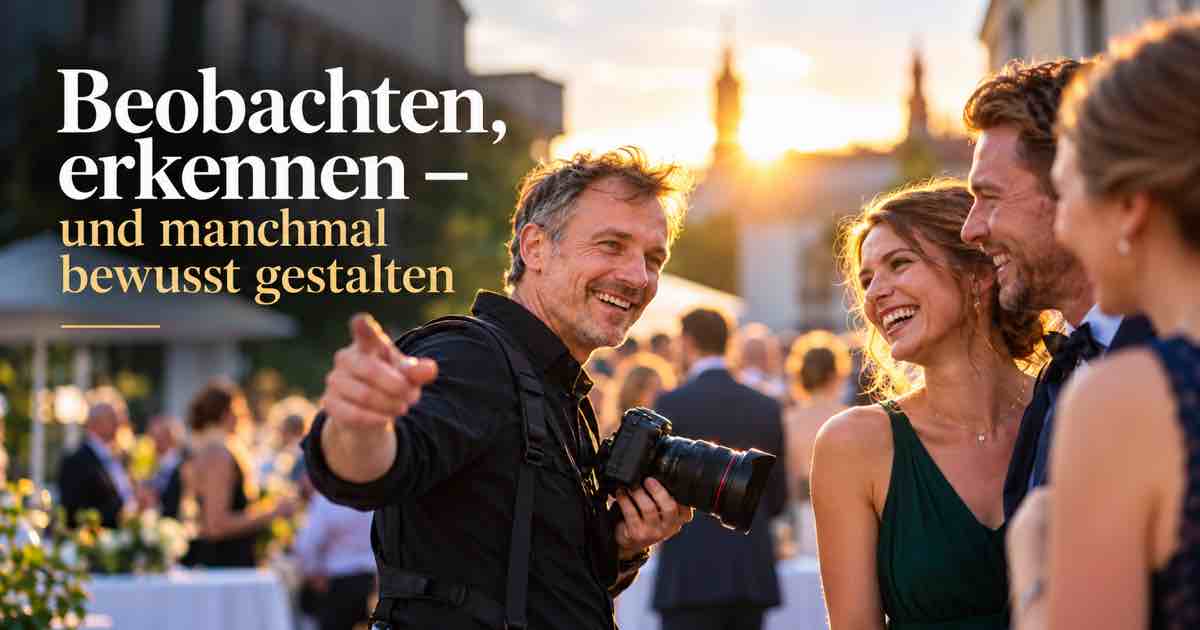
Observe, recognize – and sometimes consciously shape
The photographer should be barely noticeable during events. Yet, for important moments, they must be right there. And at least half of the pictures that are later most cherished come from a small, conscious connection.
Even eye contact, a gesture, showing the camera, my own smile, or a friendly address to individuals and groups enables pictures that purely passive photography cannot produce. This is not artificial staging. It is the ability to make the most of a real situation.
A good photographer knows both roles: they can observe quietly without disturbing a scene. And they can lead when people need guidance.
The photographer as a connection between people
At an initially anonymous event, the photographer often becomes the focal point of small encounters. They bring people together, arrange groups, and alleviate uncertainty. They pay attention to posture, clothing, light, and background without exposing people.
In dazzling sun, I explain the process, have eyes close briefly, and count down to the right moment. If a smile is missing, it might be "Yippee," "Cheese," or "Say cheese." The word is not what matters, but the spontaneous shared moment.
People want to see people
Not everyone considers themselves photogenic. Nevertheless, in a reportage, it is often precisely the people who are rarely photographed who are important. Otherwise, the question later remains: "Didn't you photograph this person?"
I photograph older people, if possible, individually, as a couple, and in family groups. Sometimes these are the last beautiful shots. The same applies to friends, colleagues, or entire groups who rarely come together. A small effort in the moment can have inestimable value years later.
In 25-year-old commemorative publications, I repeatedly experience how people talk about photos from back then: who was young, who achieved something, and who is now missing. Often the sentence follows: "That's what that photographer did back then." Good photographers do not put themselves in the spotlight – but their pictures become part of a community's memory.
This approach extends far beyond events
People
Portraits, weddings, families, and teams require trust, respect, and clear, friendly guidance.
Companies & Culture
Events, companies, and associations need complete stories: personalities, work, atmosphere, details, and relationships.
Locations & Time
Landscapes, houses, and businesses also gain photographic value as soon as they change or no longer exist.
When an event is over, memories and images remain. That's exactly what the photographer is for.
Good photographers complement each other
Professionalism also means knowing your own limits. For large events, multiple locations and crucial moments can be important simultaneously. In such cases, I work with an established network of experienced photographers.
This network creates additional perspectives and security. Should someone fall ill at short notice, a replacement can often be quickly arranged. Everyone adheres to the common briefing, mandatory motifs, and consistent delivery.
Technology and AI support us: My Aftershoot profile , trained with more than 50,000 finally edited RAW photos, accelerates selection and basic editing. Responsibility, empathy, and the final decision remain human.
My Principles
- People are more important than technology.
- Discretion and active guidance are not mutually exclusive.
- No one should be forgotten in a reportage.
- Planning, backup, and representation are part of the service.
- Editing should strengthen memories, not distort them.
- A team shares responsibility and complements perspectives.
More about professional event photography
What makes a good photographer?
What distinguishes a good photographer?
A good photographer masters their technique, but above all understands people, situations, and the future value of an image. They recognize moments, build trust, communicate clearly, and take responsibility for selection, data backup, and delivery.
Shouldn't a photographer remain as invisible as possible?
Yes, during sensitive and official moments. For groups, portraits, or unclear situations, friendly guidance helps. Good photography consciously alternates between discreet observation and active shaping.
Who photographs events and large gatherings?
Depending on the scope, a single event photographer or a coordinated team works. For large events, I plan locations, time slots, mandatory motifs, and responsibilities together with my network.
Help, my photographer got sick – what now?
Immediately ask for a professional replacement. Thanks to my extensive network, I can often quickly arrange a suitable colleague or reorganize the assignment.
Why are group photos so important?
Because some people rarely meet. Group photos document relationships and belonging – and often become more valuable over time.
Why do you intentionally photograph older people individually?
Because they can easily appear only on the sidelines at events. A dignified individual, couple, or family portrait can later become a particularly important memory.
Does a good photographer need to be a team player?
Yes. In case of cancellations or parallel program items, a reliable network protects the assignment. Teamwork also means integrating into processes and collaboratively telling a consistent story.
Can AI replace a photographer?
AI can speed up selection, sorting, and basic editing. However, it does not reliably recognize the personal significance of a moment and does not replace empathy, communication, or responsibility.
How can I identify a professional photographer before booking?
By complete reportages, clear communication, transparent usage rights, a backup concept, realistic delivery times, and the ability to plan for illness or technical problems.
For me, photography begins with responsibility
Whether it's an event, portrait, corporate, or documentary project: Let's discuss which people and moments truly matter to you.