


Johann Dirschl as a Photographer
Portrait and Business Photography
Light, exposure, aperture, expression, image statement, emotions, credibility, good mood, and the right moment are crucial for good portraits, whether as a single portrait or in a scene. With me, you get:
- Advertising shots
- Business and corporate photos
- Wedding photos
- Event photography
- Portraits
- Passport and application photos
- Baby and children's photos
- Nude and partial nude
- LowKey and HighKey
- Black and white
- Sports photography
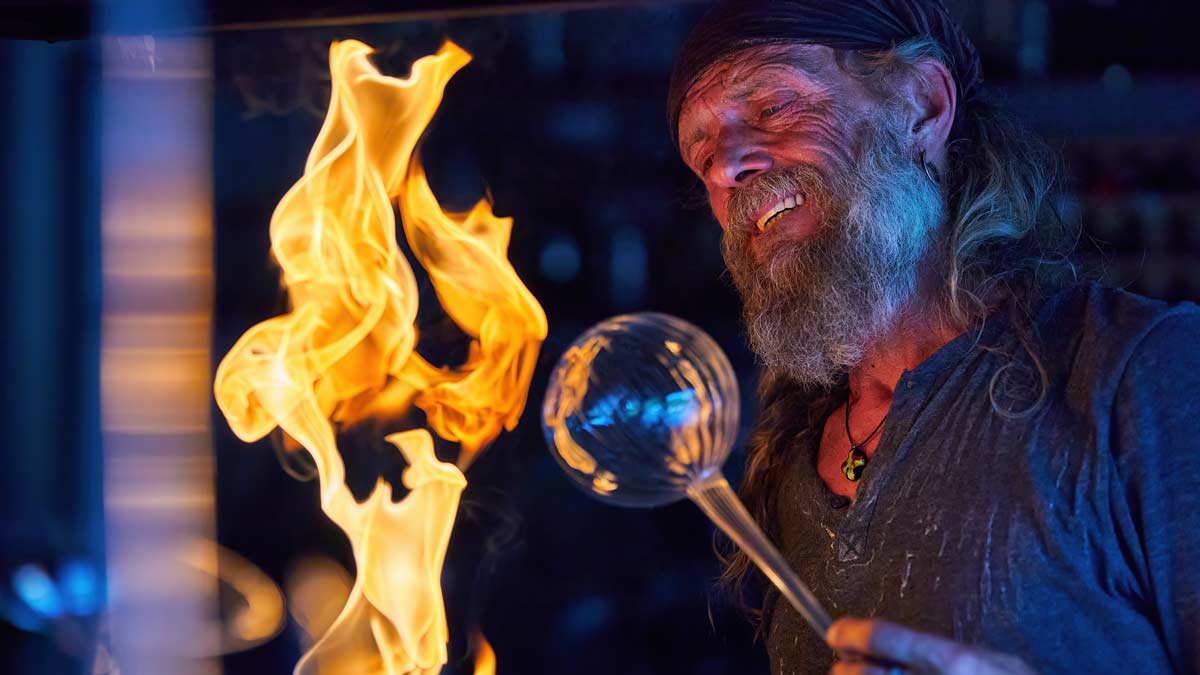
Sigi Franz, Glassblower
You in the best light – recognizable, natural, and effective for advertising
Each image should stand on its own. At the same time, a series should not look arbitrary, but have a clear, recognizable style. This is achieved not only during photography but also through careful selection and post-processing.
I generally photograph in RAW format. This preserves maximum image information, and each photo can be cleanly optimized in terms of brightness, color, contrast, and visual impact. The finished images should look natural, yet appear high-quality, clear, and professional.
AI-supported Selection and Editing
For selection and basic editing, I use Aftershoot, among other tools. Based on over 50,000 finally processed images, a unique editing style has been trained. This results in a consistent basic editing that matches my visual language.
The workflow usually consists of two steps:
First, culling takes place, which is the image selection. The software identifies blurry images, closed eyes, similar motifs, and potential duplicates. It helps to find the best shots faster.
Afterward, the basic editing of the RAW files follows. Brightness, contrast, white balance, colors, and other RAW settings are prepared. The catalog is then manually checked and further refined.
Important: No artificial AI images are created in this process. The AI does not alter people, faces, or content. It merely assists with selection, evaluation, and basic editing. The result remains natural photos – just processed more efficiently and consistently.
Lightroom and Capture One
I edit most images in Lightroom. For medium format data and smaller projects, Capture One is also sometimes used.
The editing process is one of the most time-consuming parts of the work. Depending on the project, about 200 images per hour can be reviewed, evaluated, and fundamentally processed. Nevertheless, every important image must be checked. Especially with large series, careful selection determines whether a strong, coherent image sequence is created in the end.
Lightroom also offers excellent options for noise reduction, local correction, and masking. In combination with the preliminary work from Aftershoot, this allows for very efficient work without sacrificing quality.
If you want to save costs on large projects, you can take over certain work steps yourself, for example, the final image selection. This can reduce project costs by about 40 percent, depending on the scope.
Evoto for Retouching and Cutouts
If images require particularly high-quality retouching or perfect cutouts, I also offer editing with Evoto.
Evoto is a specialized AI program for professional retouching. Especially for skin retouching, portraits, clothing, backgrounds, and cutouts, it is often significantly faster than classic manual editing in Photoshop.
Editing costs 5 Euros per image. This includes the actual work as well as license and AI costs. Each image is still manually checked and individually adjusted. The largest part of the work therefore remains the professional decision: What should be improved without making the image look artificial?
The result is particularly interesting for application photos, business portraits, advertising, cutouts, social media, and high-quality presentations.
Training in Portrait Photography and Image Editing
For over 20 years, I have also worked as a photography instructor – in companies, projects, and formerly regularly at the VHS (community college). Today, such training sessions primarily take place upon request.
The smartphone has significantly changed private photography. AI also automatically improves many images. Nevertheless, this does not replace photographic experience. Anyone who understands how light, perspective, exposure, focal length, and image composition work achieves visibly better results.
In practical training sessions, I demonstrate the confident handling of light and exposure, sensible camera settings, the composition of good portraits, and the complete path from photo to finished editing. Such training can also be directly combined with a specific project.