


Photography
Micro Photography in Polarized Light - Magnified Photography
Micro or magnified photography has long been used in photography. The crystallization of elements is a special form that can create beautiful structures and rich colors.
Polarized light is a playground for preserving old photographic knowledge.
Experimental Photography
Johann Dirschl
Example video:
Paracetamol on a microscope slide with 2 polarizing filters mounted crossed on the light source and lens.
What is polarized light
Light is scattered, but can also be directed using a polarizing filter if you place it in front of the light source. If you then attach a second polarizing filter rotated 90°, the scattered lights cancel each other out, and you get a black surface. Elements that deflect light now become particularly well and colorfully visible. Some microscopes also have the polarizing function. Especially in the industrial sector, this can be used to detect stresses in materials, for example.
The technique can also be used to eliminate reflections. For this, you also need 2 polarizing filters. In this case, however, not as transmitted light, but as incident light. The effect is astonishing, as it allows photos that would otherwise only be possible under perfect studio conditions.
Smallest scales under 1 mm and Stacking
In pure photography, the limit is reached at 5:1, and even then, nothing must wobble. Of course, more is possible, but then you absolutely need a microscope objective, preferably a Mototoyo 50 or 100x or comparable from Zeiss and Co. An automatic macro rail with an extremely small step size would also be great. Here I'm eyeing the
which I discovered on an Instagram channel:https://www.instagram.com/medienbunker_produktion/
But it's also fun with a reproduction ratio of 3:1 or more, and since the microscope slides are flat, you don't necessarily have to stack. Nevertheless, the height of some crystals should not be underestimated, so I additionally sharpen the images. This works best with Topaz Sharpen AI.
What do you need for this?
I use the following:
- Canon mp-e 65mm magnified lens 1:1 - 5:1 with step-up rings to 82mm polarizing filter
- Camera with macro rail pointed downwards
- Lupine Betty 2 for light from below with step-up ring for 82mm polarizing filter
- 2x 82mm polarizing filters (camera and flashlight)
- Bresser microscope slides (or other glass plates, reusable)
- 5-10 spoons and a lighter for mixing and heating ingredients
- Pipette for ISO propanol, water, etc. for better dosing
- Toothpick as a spacer for microscope slides on the polarizing filter
- Crystallizing substances, best found online by searching for Micro Photography Polarized Light. These include B-Alanine, Vitamin C, Paracetamol, Aspirin, Sulfur, Baking Soda, Citric Acid, Copper Sulfate, Caffeine...
- For editing: RAW converter, Photoshop with Topaz Sharpen AI
Basically, you can photograph many things with this setup, but polarized light really shines with some substances.
You can mix almost anything with anything, and the results always vary. Even with just one ingredient, many different motifs can be recognized. It is therefore a quite experimental type of photography that will be fun for a certain period.
My course participants are welcome to borrow everything they need. Beta Alanine, MSM, and similar are usually only available in larger containers, which are then never fully used. All these substances also have an effect, e.g., as dietary supplements, laxatives, medication... I currently only use household substances that are not toxic in small quantities.
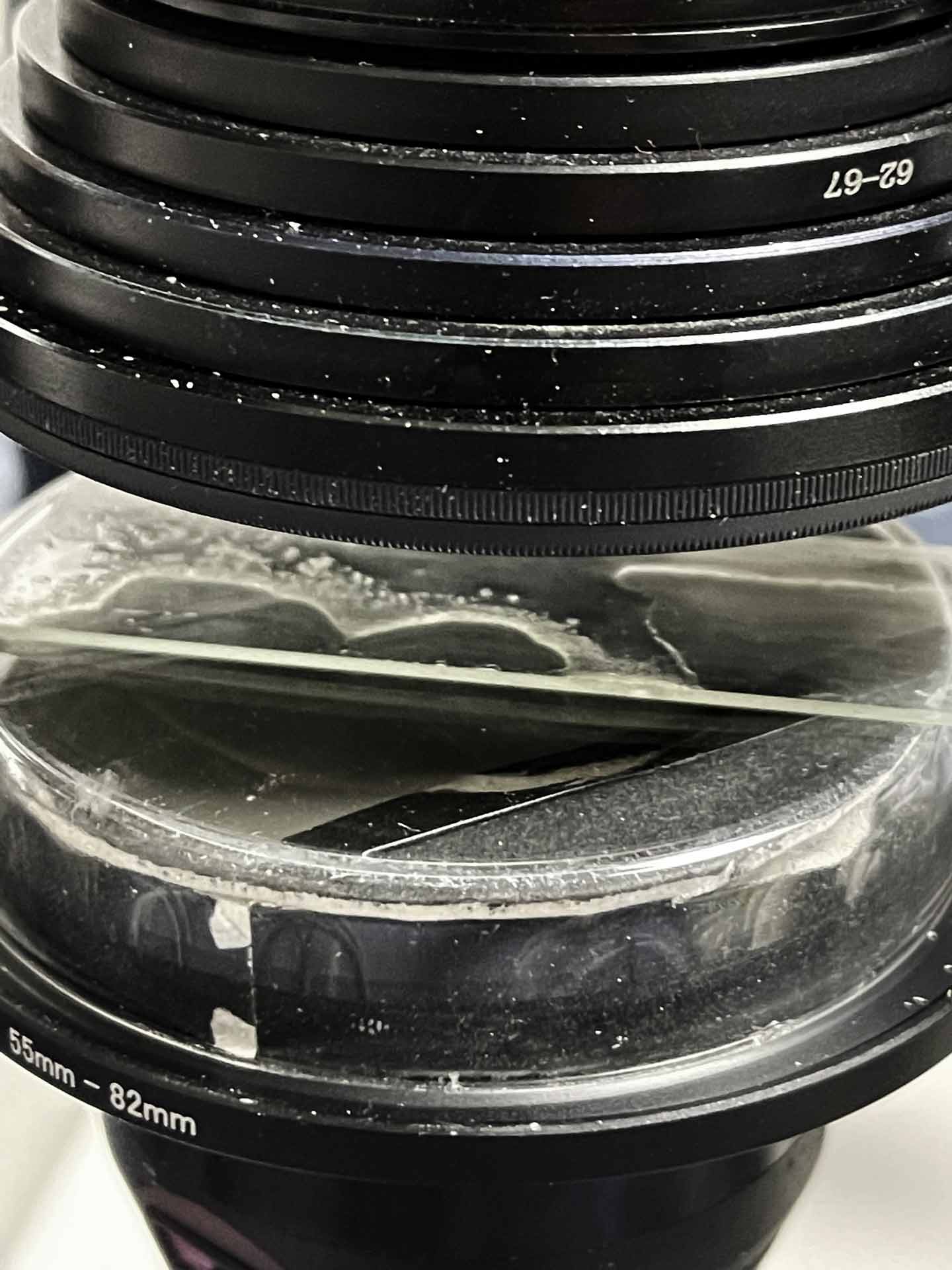
Photo of my setup consisting of a light source, polarizing film under an inverted petri dish, microscope slide, and polarizing filter on the lens. The camera is attached to the macro rail.
Training for Magnified Photography
I offer training for everyone interested in macro and magnified photography.