AI Search, GEO & SEO for Businesses
Get Visible in AI Search – with Answers That Get Cited.
Identify Questions. Structure Expertise. Systematically Expand Visibility.
Google, AI search systems, and digital assistants answer increasingly complex questions directly. We analyze what your target audiences are searching for, develop robust answer pages, and build a measurable SEO and GEO strategy for your business based on this.

No Ranking Guarantee and No AI Trick: Good technical SEO, original expert information, verifiable sources, and useful answers remain the foundation.
The Problem
Valuable expertise and genuine customer questions on many websites are not structured in a way that Google and AI search systems can reliably find and categorize them.
The Solution
We combine Search Console, Matomo, SEO, GEO, and a clear WordPress structure with robust answer pages.
Your Result
More qualified traffic, measurable visibility, and a website that can be developed as a verifiable source for classic and generative search.
Cost Structure
The primary effort lies in setting up the page, data, and content structure. After that, analysis and optimization can be largely automated; ongoing license costs generally remain low.
Your Website Is Your Most Important Digital Marketing Tool
Publishing good answers creates new entry points for customers.
A website should not only explain what a company is. It can answer specific questions, prepare decisions, explain technical contexts, and become a citable source with robust data. These contents can appear as an additional source in classic search results, Google AI Overviews, AI Mode, and other AI answer systems.
Google clarifies: The known SEO fundamentals still apply to generative search functions. Pages must be indexable, important content must be available as text, internal links must be discoverable, and structured data must match the visible content. Nevertheless, no one can guarantee inclusion or a citation.
SEO
Technical accessibility, indexing, search intent, internal linking, and helpful content form the basis.
GEO / AEO
Answers become so substantial, unambiguous, and verifiable that they are also useful for generative systems and AI answer systems.
Conversion
Each answer page meaningfully leads to services, references, consultation, or contact – without withholding the actual answer.
Learn from real search data
What questions are your potential customers already asking?
The Google Search Console shows search queries for which a website has received impressions or clicks. Long search queries can be grouped using a custom regex filter. This reveals complex questions and topics that might easily be overlooked in short keyword lists.
At least six words – exact full search query
^([^ ]+ ){5,}[^ ]+$At least 60 characters
^.{60,}$Questions with specific content
wie|was|warum|welche|wannApplication: Search Console → Performance → Search results → Add filter → Query → Custom (Regex). Google uses RE2 and evaluates regex as partial matches by default; the start ^ and end $ limit the expression to the full search query.
The filter does not provide a complete list of all potential customer questions. It shows the search queries for which data already exists in the property. Additionally, we analyze internal search, sales conversations, service questions, competitors, product specifications, and editorial content gaps.
1. Collect questions
Consolidate Search Console data, customer inquiries, sales, support, product knowledge, and existing content.
2. Check search intent
Distinguish between information needs, comparison, planning, costs, suitability, troubleshooting, or concrete purchase intent.
3. Prioritize potential
Evaluate business relevance, existing visibility, professional authority, data availability, and appropriate next steps.
New Measurement Capabilities in Search Console
The „Generative AI“ report makes visibility more transparent.
In 2026, Google introduced its own performance reports for generative AI features in Search and Discover. Among other things, they show impressions, displayed pages, countries, devices, and temporal developments for AI Overviews, AI Mode, and other generative search interfaces.
The report does not replace classic search query analysis and does not automatically explain why a source was selected. However, it provides an additional measurement point: Which URLs already appear in generative search features, and how does this visibility change over time?
Search Queries
Group long and business-relevant queries by topic, intent, and existing position.
Generative Visibility
Compare impressions and displayed pages in the „Generative AI“ report over fixed periods.
Business Results
Measure qualified contacts, downloads, inquiries, and orders with Matomo or existing web analytics.
Citable, not just verbose
A good AI source provides verifiable building blocks for an answer.
“AI loves numbers” is understandable as an abbreviation, but technically too imprecise. What matters is concrete, correctly categorized, and verifiable information. Numbers become particularly valuable when the unit, period, assumptions, formula, data source, and scope of validity are specified.
Direct Answer
The core question is answered early and unambiguously. This is followed by justification, variations, limitations, and next steps.
Numbers with Context
Not just „fast“ or „large,“ but for example, 5–10 business days from approval or 3 variants with clear dimensions.
Evidence and Experience
Proprietary metrics, references, verifiable calculations, and reputable primary sources create substance.
Accountability
Author, company, field of expertise, update date, and contact information make it clear who stands behind the statement.
Clean Structure
Descriptive headings, lists, tables, units, and internal links help people and machines categorize information.
Clear Boundaries
Assumptions, regional differences, legal or technical review obligations, and uncertainties are explicitly stated.
WordPress as a Knowledge and Publishing System
A custom guide plugin is more flexible than a typical blog.
A blog usually sorts content chronologically. For multiple business areas, a specialized structure is more effective: central question management, dedicated topic areas, fixed permalinks, categories, responsibilities, sources, update dates, internal linking, and appropriate structured data.
The plugin can generate overview pages and detailed individual pages from an editorially reviewed catalog of questions. New answers are assigned to the relevant services, products, and references. AI supports research, drafting, and linking; expert approval remains with the company.
Question Catalog
Centrally manage questions, short answers, detailed answers, specialized areas, target audiences, sources, authors, status, and review dates.
Flexible Permalinks
Guides can appear directly under their respective business area instead of mixing all topics in a general blog.
Automatic Linking
Relevant questions, services, references, and contact methods are linked in a controlled manner.
Measured Schema Implementation
Structured data accurately represents visible content. It is not a special access pass to AI search and no guarantee for rich results.
Practical Example: Oberhauser Bau-Systeme
Multiple business areas receive their own, thematically relevant guides.
At OHBAU, we have already implemented the guide system as a WordPress plugin. Questions are not collected in a single unspecific archive but are assigned to their respective business unit. Overview pages bundle the topics, and individual questions receive independent, detailed, and internally linkable permalinks.
This example demonstrates how various services, regional questions, technical topics, and consulting situations can be represented within a common editorial logic.
What truly helps today – and what should not be overestimated
FAQ schema and llms.txt are enhancements, not the strategy.
FAQ Content
Well-answered questions are useful because they address real information needs. A dedicated page is worthwhile if the answer has sufficient substance and a clear professional context.
FAQPage Schema
Schema can describe visible questions in a machine-readable format. However, Google does not require a special schema for generative AI; FAQ rich results have not been a general search feature since 2026.
llms.txt
A well-maintained llms.txt can be offered to other services as voluntary guidance. Google Search explicitly ignores it; it improves neither visibility nor ranking there.
Our recommendation: First, establish crawlable HTML content, clear information architecture, internal links, primary sources, and measurable user goals. We only implement additional files and markup where they serve a clear purpose.
Continuous Improvement Instead of One-Time Content Production
Our Process for SEO, GEO, and AI Visibility
1. Understand the Business
Identify business areas, target audiences, services, regions, references, expertise, and conversion goals.
2. Analyze Data
Examine Search Console, website, internal search, Matomo, sales, and support for relevant questions and topic clusters.
3. Prioritize Strategy
Improve existing pages, plan new answer pages, and organize topics by business value and data availability.
4. Implement the System
Set up WordPress structure, guide plugin, permalinks, internal links, metadata, and appropriate structured data.
5. Publish Answers
Develop AI-supported drafts into robust pages with expert knowledge, figures, sources, images, references, and human approval.
6. Measure and Improve
Review indexing, search queries, generative visibility, user behavior, and inquiries; strategically expand successful topics.
Frequently Asked Questions about AI Search and GEO
What is the difference between SEO and GEO?
SEO optimizes overall discoverability in search engines. GEO – Generative Engine Optimization – additionally considers how content can be used as helpful sources in generative answers. The technical and content-related SEO foundation remains crucial for this.
Can a placement or citation in AI answers be guaranteed?
No. Search and AI systems dynamically decide which sources they display. We improve technical accessibility, information quality, structure, and measurability, but we do not guarantee ranking or citation.
Does every question need its own page?
No. Closely related questions can be answered on a strong topic page. A dedicated page is useful if the question warrants a detailed, standalone, and business-relevant answer.
Does FAQ schema help with AI search?
Structured data can clearly describe visible content. However, Google does not require a specific schema for generative search features. Schema must be correct and does not replace good answers, indexing, or internal linking.
Is an llms.txt file necessary?
No. Google Search does not use llms.txt. For other services, the file can be optionally maintained if its content remains current; however, it is not a substitute for accessible HTML pages.
Can AI automatically publish answer pages?
Technically, this is possible, but professionally risky. We recommend a controlled workflow with source verification, responsible parties, approval status, and regular updates.
From AI Search Strategy to a Repeatable WordPress Workflow
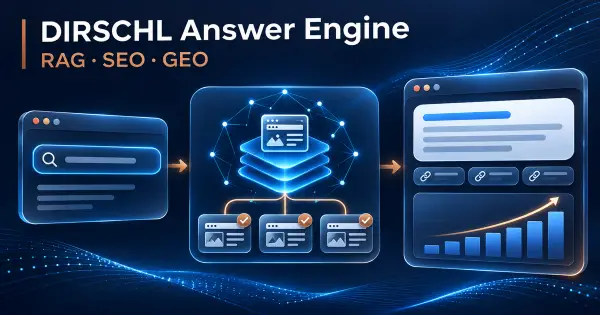
RAG (Retrieval-Augmented Generation) retrieves approved website knowledge before generating an answer. Our DIRSCHL Answer Engine transforms this into a practical process: identifying measured questions in GSC, determining the best existing page, maintaining citable answers, and measuring direct source clicks.