


AI Knowledge · Systems and Automation
RAG, APIs, AI Agents, and Local Models Explained
How AI accesses its own data, uses tools, and is securely integrated into workflows.
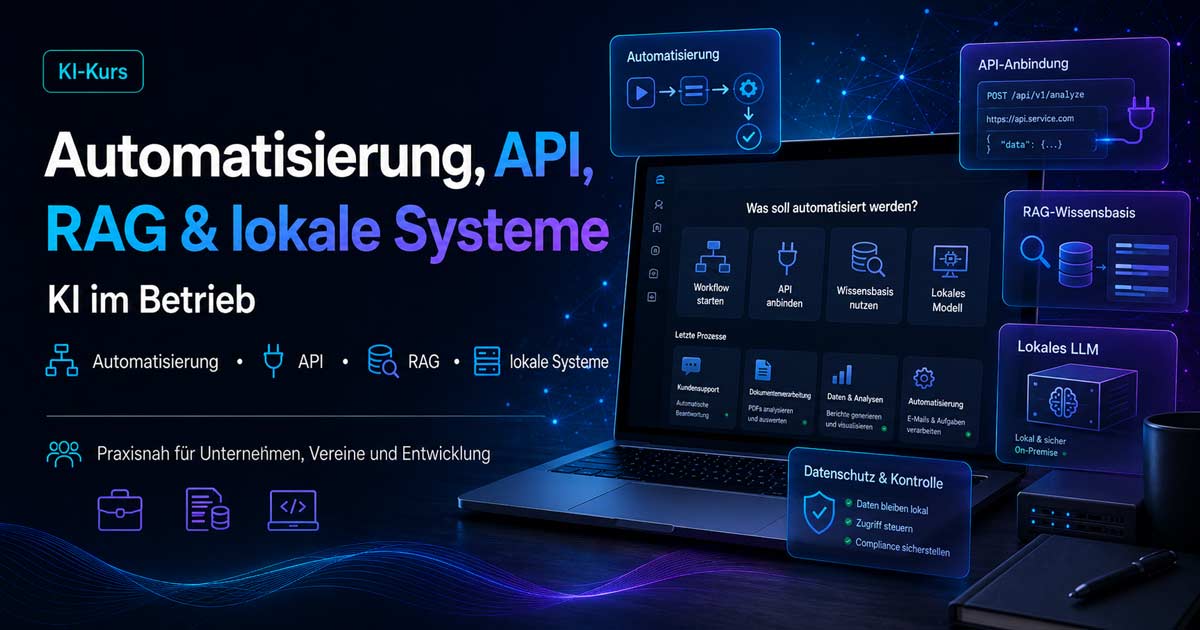
From Chat Window to Robust AI System
A chat is suitable for individual tasks. In a business, however, value is only created when data, permissions, processes, and quality controls are connected. A robust AI system therefore consists of several building blocks: interface, model, sources, tools, rules, logging, and human approvals.
This separation prevents dependency. The language model can be exchanged, while document search, WordPress integration, or the approval process remain. This is precisely why good architecture is more important than choosing the currently most popular model.
API: The Defined Gateway to a Model
An API is an interface through which software sends structured requests and receives responses. Instead of manually copying text into a chat window, WordPress can, for example, transmit page text, language, and the desired output format. The response can be saved, checked, or passed to a further step.
Professional APIs require authentication, time limits, error handling, cost control, and a fixed data format. Structured JSON outputs are more reliable than subsequently extracting freely formulated texts.
RAG Step by Step
RAG stands for Retrieval-Augmented Generation. First, documents are cleaned and broken down into meaningful sections. An embedding model converts each section into a vector. When a question is asked, the question is also embedded; a vector search finds semantically similar sections. The language model receives these sources along with the instruction to formulate an answer.
- Select and maintain sources
- Break text into understandable, self-contained sections
- Generate and index embeddings
- Analyze question and retrieve relevant sections
- Generate answer exclusively using the sources
- Output links, citations, and uncertainty
RAG does not retrain the model. It provides knowledge at runtime. Therefore, changes to a website can be re-indexed immediately.
Chunking, Vector Database, and Hybrid Search
In chunking, a document is broken down into sections. Chunks that are too small lose context; those that are too large contain too many secondary topics. Headings, page titles, language, date, and URL should be preserved as metadata.
A vector database stores embeddings and metadata. Pure vector search finds meaning but can be weak for product numbers or names. Hybrid Search combines semantic search with classic keywords and then improves the ranking through reranking.
RAG Is Not Automatically True
RAG reduces hallucinations but does not eliminate them. Poor sources, outdated documents, or an inappropriate retrieval still lead to incorrect answers. Therefore, citation rules, minimum similarity, language filters, version data, and a clear fallback are needed: “No reliable source is available for this.”
Quality is measured with real test questions. Important factors are search hit rate, source coverage, answer fidelity, timeliness, and the proportion of unanswerable questions that are correctly rejected.
Workflow or AI Agent?
A workflow follows predefined steps and is easily verifiable. An agent can decide for itself within a framework which tool or intermediate step is necessary. For invoices, publications, or customer data, a controlled workflow is often better.
Agents are useful when the path is not entirely predictable – for example, when researching across multiple sources. Secure agents receive only the minimum necessary rights, limited runtime and costs, and approval points before external changes.
Tools, MCP, and Permissions
Models become more powerful when they use tools: search, calendar, file system, database, browser, or code execution. Protocols like MCP standardize how such tools are described and invoked. This does not give the model magical abilities, but rather a controlled interface.
Each tool simultaneously expands the attack surface. Inputs from websites or documents can contain hidden instructions. Protective measures include whitelists, separate read and write permissions, confirmation before changes, isolated execution, and comprehensive logs.
Local AI, Cloud, and Hybrid Architecture
Local models keep data within your own network and avoid per-request costs. They require hardware, storage, updates, and monitoring. Cloud models often offer higher peak performance and scalability, but they transfer data to a service provider and incur variable costs.
A hybrid architecture routes tasks: sensitive documents locally, demanding general analysis in the cloud as needed, rule-based tasks without AI. Quantization and smaller specialized models reduce memory requirements. On Apple Silicon, the CPU and GPU share Unified Memory, which enables large local models but does not automatically accelerate every operation.
Our Local Media Stack: LTX, LightX2V, and ACE-Step
Local AI is not limited to text. LTX 2.5 generates and edits audio-video content. LightX2V accelerates and unifies the execution of various image and video models. ACE-Step generates music locally.
Together with local language models, this creates a private production environment for text, code, image, video, speech, sounds, and music. Not every local result immediately matches the best cloud service. The decisive advantage, however, is the independent learning curve, data control, and a workflow whose components will remain interchangeable in the future.
Practical Example: DIRSCHL Answer Engine
The Answer Engine combines page search, a catalog of questions, and citable answers. Questions arise from real search queries, editorial research, and gaps in existing content. Each answer is assigned to a canonical page, internally linked, and rendered server-side.
This creates not an isolated chatbot, but a growing knowledge architecture. Good existing pages remain prioritized; new guides are created only if a question does not yet have a suitable target page. Views and clicks can be measured with Matomo, while Search Console provides new topics.
Security, Data Protection, and Governance
Before implementation, data classes, authorized providers, retention periods, and responsible parties are defined. Personal data, trade secrets, and access credentials should not be put into prompts without review. Logs should be traceable but should not collect unnecessary sensitive content themselves.
Responsible operation includes model and prompt versions, test cases, role permissions, approvals, emergency shutdown, and a procedure for corrections. Quality is not a one-off approval, but ongoing monitoring.
Make Costs and Success Measurable
Total costs are not just about tokens. Data preparation, integration, testing, hardware, maintenance, and human review are often more important. A smaller model with good RAG can be more cost-effective and reliable than a large model without suitable sources.
Meaningful key performance indicators include processing time, cost per successful operation, correction rate, source coverage, user satisfaction, and actual triggered requests. Automation is only successful when the entire process improves – not just when more text is generated.
The Future: Specialized Models as an Interchangeable Team
Future AI systems will distribute tasks among language, vision, audio, video, and control models. Small local models will handle frequent or sensitive tasks, while large models will manage complex individual cases. Agents will operate more within software interfaces, with rules and approvals defining their boundaries.
Companies should therefore not bet on a single provider. Future-proof solutions rely on clean data, open interfaces, measurable tests, and processes where models are interchangeable. Those who build these foundations today can deploy new models tomorrow without starting from scratch.
Further Knowledge and Consulting
The model fundamentals are explained in GPT, LLM, Tokens, and Transformers. Image, video, and audio models are covered under Vision Models and Generative Media. For visibility and citable content: AI Search and GEO.