


Great Photos Require Connection – and Responsibility
Great photos don't just happen because the photographer always works unobtrusively in the background. Instead, they emerge when the photographer understands situations, instills confidence in people, and takes responsibility at the crucial moment.
My photographic guidelines for events, portraits, businesses, and documentary projects.
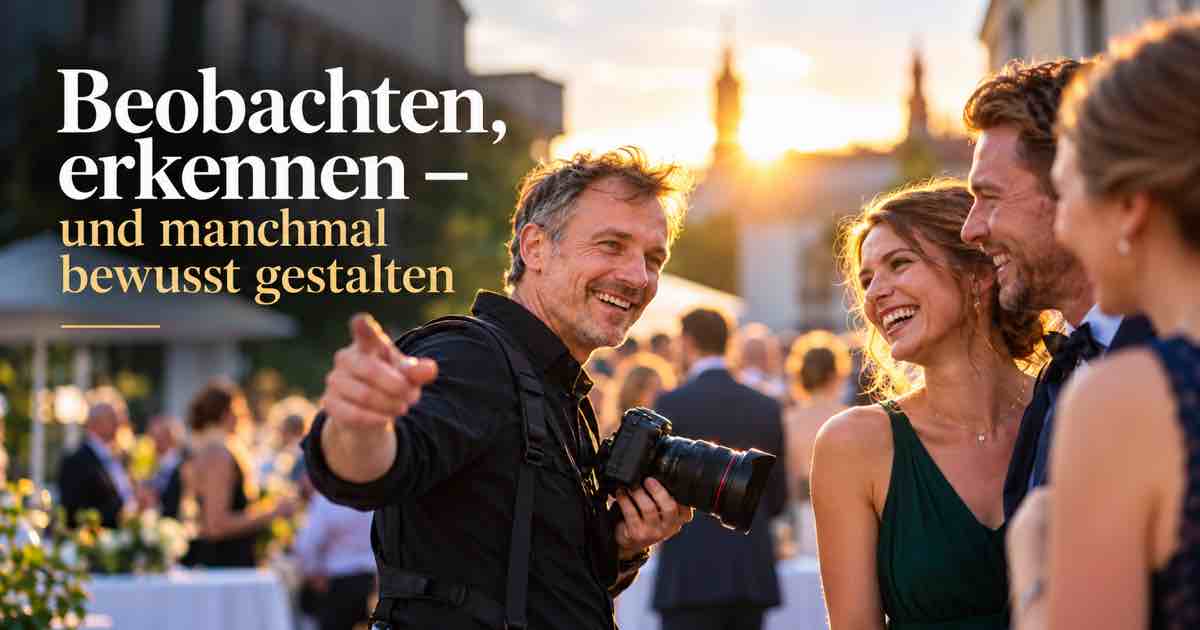
Observe, Understand – and Sometimes Actively Shape
During events and functions, the photographer should ideally be barely noticeable. Yet, for crucial moments, they must be right there. And at least half of the pictures that are later most treasured are created through a subtle, intentional connection.
Even eye contact, a gesture, showing the camera, my own smile, or a friendly address to individuals and groups yields photos that purely passive photography cannot achieve. This isn't artificial staging. It's the ability to capture the best from a genuine situation.
A good photographer understands both roles: They can observe discreetly without disturbing a scene. And they can provide guidance when people need direction.
The Photographer: Connecting People
At an initially anonymous event, the photographer often becomes a catalyst for small interactions. They bring people together, arrange groups, and ease discomfort. They pay attention to posture, clothing, light, and background without making people feel exposed.
In dazzling sunlight, I explain the procedure, have people close their eyes briefly, and count down to the opportune moment. If a smile is missing, it could be "Yippee," "Say cheese," or "Cheesecake." The specific word isn't what matters, but the spontaneous shared moment.
People Want to See People
Not everyone considers themselves photogenic. Nevertheless, in a photo essay, the people who are rarely photographed are often the most important ones. Otherwise, the question later arises: "Didn't you photograph this person?"
Whenever possible, I photograph older individuals individually, as a couple, and in family groups. Sometimes these are the last treasured images. The same applies to friends, colleagues, or entire groups who seldom gather. A small effort in the moment can prove invaluable years later.
In 25-year-old commemorative publications, I repeatedly observe people discussing photos from that time: who was young, who accomplished something, and who is no longer with us. Often, the remark follows: "That's what that photographer did back then." Good photographers don't seek the spotlight – but their pictures become integral to a community's memory.
This Approach Extends Far Beyond Events
People
Portraits, weddings, families, and teams require trust, respect, and clear, friendly guidance.
Businesses & Culture
Events, companies, and associations require comprehensive narratives: personalities, work, atmosphere, details, and relationships.
Places & Time
Landscapes, houses, and businesses also acquire photographic significance once they change or cease to exist.
Once an event concludes, memories and images endure. That's precisely the photographer's purpose.
Good Photographers Complement Each Other
Professionalism also means recognizing one's own limitations. At large events, multiple locations and crucial moments can occur simultaneously. In such instances, I collaborate with an established network of experienced photographers.
This network provides additional perspectives and assurance. Should someone become ill on short notice, a replacement can often be quickly arranged. Everyone adheres to the common briefing, required shots, and consistent output.
Technology and AI assist us in this: My profile, trained with over 50,000 finally edited RAW photos,Aftershoot profileaccelerates selection and initial editing. Responsibility, empathy, and the final decision remain human.
My Principles
- People matter more than technology.
- Discretion and active guidance are not mutually exclusive.
- No one should be forgotten in a reportage.
- Planning, backup, and representation are part of our service.
- Editing should strengthen memories, not distort them.
- A team shares responsibility and complements perspectives.
More about professional event photography
What makes a good photographer?
What distinguishes a good photographer?
A good photographer masters their craft, but above all, understands people, situations, and the future value of an image. They recognize moments, build trust, communicate clearly, and take responsibility for selection, data backup, and delivery.
Shouldn't a photographer remain as invisible as possible?
Yes, for sensitive and official moments. For groups, portraits, or unclear situations, friendly guidance helps. Good photography consciously alternates between discreet observation and active composition.
Who photographs events and large gatherings?
Depending on the scope, a single event photographer or a coordinated team will work. For large events, I plan locations, timeframes, essential shots, and responsibilities together with my network.
Help, my photographer is sick – what now?
Immediately ask for a professional replacement. Thanks to my extensive network, I can often quickly arrange a suitable colleague or reorganize the assignment.
Why are group photos so important?
Because some people rarely meet. Group photos document relationships and belonging – and often become more valuable with increasing time.
Why do you consciously photograph older people individually?
Because they can easily appear only on the sidelines at events. A dignified individual, couple, or family portrait can later become a particularly important memory.
Does a good photographer need to be a team player?
Yes. In case of absences or parallel program items, a reliable network protects the assignment. Teamwork also means integrating into workflows and collaboratively telling a consistent story.
Can AI replace a photographer?
AI can accelerate selection, sorting, and basic editing. However, it does not reliably recognize the personal significance of a moment and replaces neither empathy, communication, nor responsibility.
How do I recognize a professional photographer before booking?
By complete reportages, clear communication, transparent usage rights, a backup concept, realistic delivery times, and the ability to plan for illness or technical problems.
For me, photography begins with responsibility.
Whether it's an event, portrait, corporate, or documentary project: Let's talk about which people and moments truly matter to you.